Full 6-DOF flight
Nonlinear six-degrees-of-freedom dynamics with rigorous variable-mass effects.
Open source · 6-DOF rocket flight simulation
RocketPy is the next-generation, open-source simulator for High-Power Rocketry — a full six-degrees-of-freedom flight built on real weather data, Monte Carlo-ready, and validated to under 1% apogee error against real launches.
pip install rocketpy Python ≥ 3.10 · also on conda-forge · runs in Jupyter & Google Colab
MIT licensed · 1,036★ on GitHub · 170k+ total downloads · used on 6 continents
Updated August 2026 · star us on GitHub
Quickstart
Describe the sky, the motor, and the rocket — RocketPy handles the full 6-DOF physics. Here is a complete simulation of the Calisto rocket, ready to run in a notebook or Google Colab.
EnvironmentPull real forecast, reanalysis or sounding data for launch day.
MotorPick a variant — SolidMotor, HybridMotor, LiquidMotor or GenericMotor — each built from its thrust curve and geometry.
RocketAdd nose cone, fins, tail and parachutes with real aerodynamics.
FlightLaunch it and explore trajectory, forces and recovery.
from rocketpy import Environment, SolidMotor, Rocket, Flight
# 1 · Describe the sky — real forecast weather
env = Environment(latitude=32.99, longitude=-106.97, elevation=1400)
env.set_atmospheric_model(type="Forecast", file="GFS")
# 2 · Build the motor (SolidMotor here — also Hybrid/Liquid/Generic)
motor = SolidMotor(
thrust_source="Cesaroni_M1670.eng",
dry_mass=1.815, grain_number=5, nozzle_radius=0.033,
)
# 3 · Assemble the rocket
calisto = Rocket(radius=0.0635, mass=14.426, inertia=(6.32, 6.32, 0.034))
calisto.add_motor(motor, position=-1.255)
calisto.add_nose(length=0.558, kind="von karman", position=1.278)
calisto.add_trapezoidal_fins(n=4, root_chord=0.12, tip_chord=0.06, span=0.11)
calisto.add_parachute("Main", cd_s=10.0, trigger=800)
# 4 · Fly it — full 6-DOF simulation
flight = Flight(rocket=calisto, environment=env, rail_length=5.2)
flight.all_info()See what it produces
One simulation yields the full picture — 3D trajectory, kinematics, stability, and the statistical landing footprint that matters for a safe recovery.
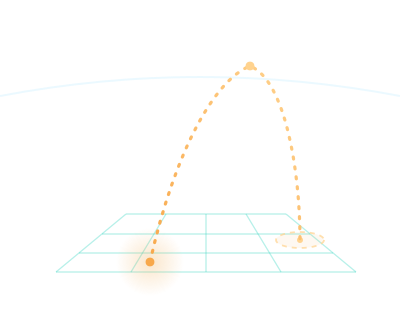
Full flight path in space — exportable to Google Earth via KML.
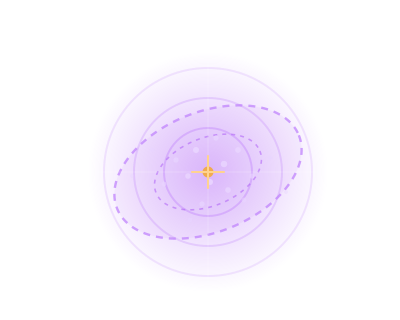
Thousands of runs give the landing ellipse and its confidence interval.
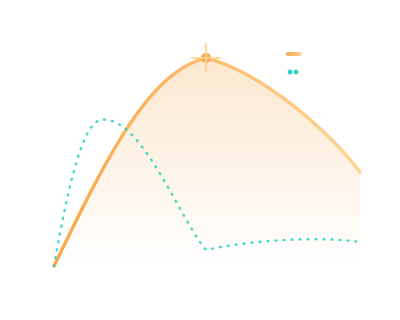
Every flight variable resolved continuously versus time.
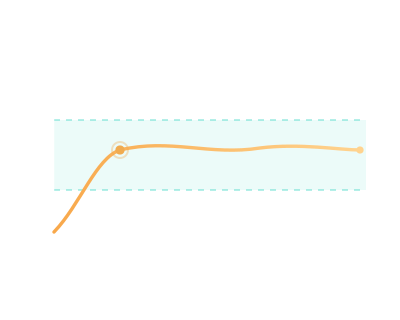
Track the static margin through the burn to stay in control.
Capabilities
High-fidelity physics under the hood, a clean Python API on top — from propulsion to recovery, weather to control.
Nonlinear six-degrees-of-freedom dynamics with rigorous variable-mass effects.
Dispersion analysis and global sensitivity for landing-ellipse prediction.
Model any propulsion type straight from a thrust curve or .eng file.
Nose cones, fins and tails via Barrowman equations, plus custom drag curves.
Multiple chutes with custom trigger functions and sensor-noise simulation.
ISA 1976, Wyoming soundings and live NOAA / ECMWF forecast and ensemble data.
Simulate staged vehicles with independent motors, events and recovery.
Inject continuous or discrete control for fins, air-brakes and active systems.
Static margin, damping and out-of-rail conditions resolved across the flight.
Emulate accelerometers, gyroscopes and barometers with realistic noise.
Script it in Python or drive it from MATLAB — and export results anywhere.
Export trajectories to KML and fly them over real terrain in Google Earth.
Proven in the field
<1%
Because RocketPy flies on the actual sky — real forecast, reanalysis and sounding data — its predictions match reality. It has been validated against 17 documented real flights from student and professional teams across four continents.

Flown & validated by teams worldwide
RocketPy is the official flight simulator of the European Rocketry Challenge (EuRoC) since 2022 and of the Latin American Space Challenge (LASC) since 2025 — and the RocketPy team actively supports and partners with both. It is trusted by 100+ university teams worldwide, including at the Spaceport America Cup. See all validation examples →
The constellation
RocketPy is more than a library. A whole toolchain surrounds it — import your designs, call it over an API, or simulate right in the browser.
The core 6-DOF simulation engine. pip install rocketpy and you are flying.
Convert your OpenRocket .ork designs into ready-to-run RocketPy simulations.
A RESTful Open API — and an MCP server — to run RocketPy from any app or AI agent.
Explore the API →RocketPy's web app — simulate in your browser, no install required. Point, configure, launch.
Open Jarvis →Getting started, user guide, full API reference and a contributor's guide.
Read the documentation →From rocketeers to rocketeers
RocketPy is free and MIT-licensed. It was born inside Projeto Jupiter, the student rocketry team at the University of São Paulo, Brazil — and grew into the world's leading open-source trajectory simulator, maintained by contributors on six continents.
Everyone is welcome. Ask a question, report an idea, or ship a pull request. Meet the people behind RocketPy →
For researchers
RocketPy is peer-reviewed. If it supports your research, please cite the papers below.
@article{RocketPy2021,
author = {Ceotto, Giovani H. and Schmitt, Rodrigo N. and
Alves, Guilherme F. and Pezente, Lucas A. and Carmo, Bruno S.},
title = {{RocketPy}: Six Degree-of-Freedom Rocket Trajectory Simulator},
journal = {Journal of Aerospace Engineering},
volume = {34},
number = {6},
year = {2021},
doi = {10.1061/(ASCE)AS.1943-5525.0001331}
}Ready for liftoff?
pip install rocketpy